
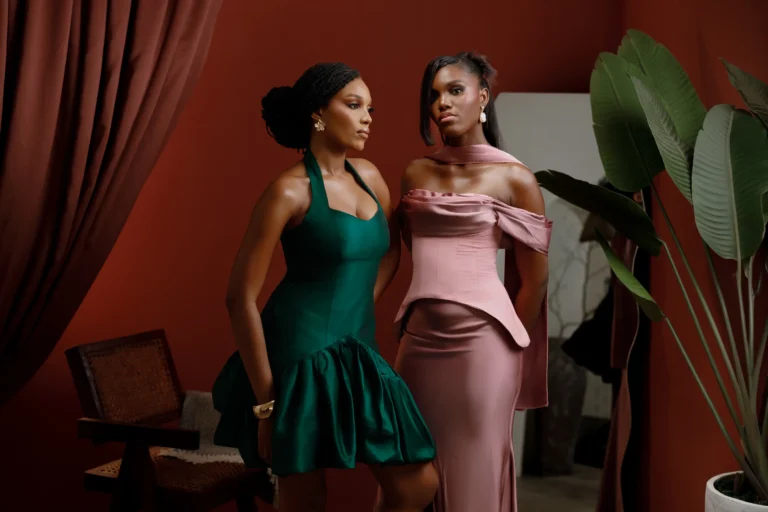
There is a specific kind of dressing that Nigerians understand in their bones — the kind that says, I arrived. Not arrived as in late, but arrived as in present, intentional, wholly herself. Nigerian occasions have always demanded this. The question is how to answer that demand without losing yourself in it.
Whether you are dressing for a Nigerian traditional wedding, a white wedding, a naming ceremony, a birthday owambe, or a formal gala, the rules are not the same as anywhere else. Nigerian occasion dressing is its own language — one built on fabric weight, colour confidence, silhouette, and a kind of quiet opulence that does not need to announce itself loudly to be felt deeply.
This guide is for the woman who wants to dress beautifully for Nigerian occasions — and dress intentionally. Not just following aso ebi, not just reaching for the nearest Ankara print because it is expected, but making a considered choice that feels like her.
Why Nigerian Occasion Dressing Is Different
Occasions in Nigeria are not background events. They are productions. A Nigerian wedding does not last two hours — it stretches across days, across traditional and white ceremonies, across pre-parties and after-parties and late nights that bleed into early mornings. The dressing must hold up — physically and aesthetically — across all of it.
There is also the matter of cultural expectation. Nigerian occasions carry an unspoken dress code that goes beyond smart-casual or black-tie. They expect coverage and modesty in some contexts, statement-making in others. They reward women who show up in considered silhouettes and fabrics that move well, photograph beautifully, and age gracefully across a long event.
And then there is the social dimension: you will be seen. Photographs will be taken. The woman who dresses well at a Nigerian occasion is remembered. This is not vanity — it is an acknowledgment that clothes, at these gatherings, are a form of participation.
“The right dress for a Nigerian occasion is not the most expensive one in the room. It is the most considered one.”
The Occasion Types. What They Each Require
Traditional Weddings & Engagement Ceremonies
Traditional weddings are where Nigerian occasion dressing is most layered and most particular. If you are part of the bridal party or family, you may be coordinating with aso ebi — a shared fabric worn by invited guests as a sign of solidarity and celebration. If you are buying aso ebi, the quality of the make matters as much as the fabric itself. A poorly constructed dress in expensive lace will always read as poorly constructed.
If you are attending as a guest outside the aso ebi group, this is where your opportunity lies. You can dress in complementary colours — deep burgundy, rich forest green, ivory, champagne — without competing with the bridal colours. Luxury Nigerian occasionwear in structured silhouettes — a column gown, a corseted midi, a cape-back dress — will always hold its own.
White Weddings & Formal Ceremonies
White weddings in Nigeria blend Western formality with Nigerian scale. The guest count is typically large, the venue is usually grand, and the photography is thorough. For these occasions, floor-length gowns, tailored trouser sets in luxury fabrics, and structured midi dresses all translate beautifully.
Fabric choice matters enormously here. Duchess satin, Mikado, and heavy chiffon photograph with a richness that cheaper synthetics cannot replicate. They also hold their shape across hours of standing, sitting, and dancing — which is exactly what a white wedding requires.
Owambes & Birthday Celebrations
An owambe is where Nigerian women dress most freely — and most boldly. There is permission here that does not exist in other contexts. Colour is celebrated. Drama is rewarded. A woman who walks into an owambe in a beautifully made gown with presence and confidence will always be remembered.
The key distinction between owambe dressing done well and owambe dressing done loudly is construction. Anyone can wear something bright and big. But the woman whose dress fits precisely, whose fabric has weight and quality, whose silhouette was chosen with intention — she is the one who comes to mind when the photos are passed around months later.
Naming Ceremonies & Intimate Celebrations
Naming ceremonies tend toward the daytime, the warm, and the familial. They call for something that is beautiful but not overwrought — a well-cut midi dress in a luxurious fabric, or a blouse and wrapper set in a refined print. The occasion is intimate, which means the details of your dressing will be more visible. Quality craftsmanship, good fit, and thoughtful accessories carry more weight here than at larger events.
Choosing the Right Fabric for Nigerian Occasions
In Nigerian fashion, fabric is not just material — it is a signal. Certain fabrics communicate wealth, taste, and care. Others communicate haste. Here is how to read them:
- Lace: The fabric of celebration. Swiss lace and French lace are the most prized. Heavy, structured lace in rich colours is appropriate for traditional and formal occasions. The make matters: lace must be lined correctly and constructed with precision or it loses its elegance entirely.
- Duchess Satin: A luxury fabric with a smooth, weighted finish. It drapes beautifully, photographs with depth, and holds a silhouette without boning or structure. Ideal for white weddings and formal occasions.
- Mikado: Structured and substantial, Mikado is the fabric of architectural dressing. It holds shape in a way that creates presence. A Mikado column gown or a-line dress has an innate formality that suits traditional and white wedding ceremonies.
- Heavy Chiffon: Lighter than the above, but when layered and cut with intention, heavy chiffon has a fluidity that is entirely its own. It is the fabric of movement — of a woman who enters a room and whose dress remembers the motion of it.
- Velvet: Reserved for the cooler months and evening occasions. Velvet is unabashedly luxurious. In deep jewel tones — midnight blue, plum, emerald — it reads as statement dressing at its most intentional.
The Silhouettes That Work Best
Nigerian occasions tend to run long and involve a range of physical activity — sitting through ceremonies, standing for photographs, dancing at receptions. The best silhouettes account for this. They are not simply the most dramatic or the most fashion-forward; they are the ones built for the full length of a day.
Column and sheath gowns are among the most reliable for formal Nigerian occasions. They photograph beautifully, require minimal adjustment throughout the day, and translate from ceremony to reception without effort. A-line silhouettes offer more movement — ideal for celebrations where dancing is expected. Cape-back and statement-sleeve designs provide drama without requiring a different outfit; the drama lives in the garment itself.
The one silhouette to approach with care is anything that requires constant management — holding up, adjusting, or restricting movement. At a Nigerian occasion, where you may be on your feet for several hours and on camera more often than you plan for, a dress that fights you will always show in how you wear it.Colour in Nigerian Occasion Dressing
Colour in Nigerian Occasion Dressing
Nigerian occasions welcome colour in a way that few other dress codes do. There is no real equivalent of the Western “do not wear white to a wedding” rule beyond the obvious — avoid upstaging the bride if you are a guest. Beyond that, the field is open.
What separates considered colour choices from arbitrary ones is not boldness — it is coherence. A woman dressed head to toe in deep ochre, her accessories and bag pulled from the same family of warmth, reads as intentional. A woman in five competing colours reads as undecided. The Nigerian occasion rewards women who commit to a vision.
Rich, saturated tones — burgundy, forest green, deep gold, ivory, plum, cobalt — tend to photograph with more depth than pastels or neons. If your goal is to look beautiful in photographs taken across a range of lighting conditions, the deeper tones are almost always the safer investment.
The Luxury Occasionwear Mindset
There is a distinction between expensive dressing and luxury dressing — and it matters. Expensive dressing is about price. Luxury dressing is about intention: the choice of fabric, the quality of construction, the fit, the way the garment was designed to sit on a specific kind of body for a specific kind of event.
The most beautifully dressed woman at a Nigerian occasion is rarely the one who spent the most money. She is the one who found a piece — or had a piece made — that fits her body precisely, was constructed with care, and was chosen with the actual event in mind. She dressed for where she was going, not for a generic idea of what “occasion dressing” looks like.
This is the ethos behind Vard Label. We design luxury Nigerian occasionwear for women who dress with intention — women who are not looking for something to fill a slot in their wardrobe, but something that becomes part of how they are remembered at a particular moment. Our debut collection, Her, in Every Form, was built entirely around this idea: that every woman contains multitudes, and her dressing should be allowed to reflect that.
A Final Note on Getting It Right
Dressing for Nigerian occasions is not a formula. It cannot be reduced to a checklist or a single rule. What it requires is self-knowledge — knowing your body, knowing the occasion, knowing the image you want to leave behind.
Start with the fabric. Let the fabric tell you what shape it wants to be in. Let the occasion tell you how much drama is appropriate. Let your body — its actual shape, not the one you imagine you should dress for — lead every other decision.
And when in doubt, err on the side of quality over quantity, of considered over busy, of fit over fashion. At a Nigerian occasion, the woman who dresses well will always be noticed. The woman who dresses with intention will always be remembered.